Where rivers meet the frame
Practical notes on photographing ponds, streams, and river habitats across Poland — from the Biebrza wetlands to the San valley. Equipment, light, and field ethics.

Gray heron (Ardea cinerea) over open water. Wikimedia Commons / CC BY-SA.
Latest articles
Field notes & guides
Three topics that come up repeatedly when photographing freshwater habitats in Poland.

Reading Light by Water
How water surfaces behave under different sky conditions and how to use overcast, golden hour, and side-lit scenes in freshwater photography.
Read article
Equipment for Freshwater Photography
Lenses, tripods, and accessories suited to river and pond environments in Poland, including gear choices for wet conditions and low-light shooting.
Read article
Ethical Wildlife Observation in Poland
Practical considerations for observing and photographing wildlife in Polish protected areas, including Natura 2000 sites and national parks.
Read articleAbout this site
Freshwater habitats deserve close attention
Poland holds an unusually varied set of freshwater environments: braided rivers in the Tatra foothills, slow oxbow lakes in the Vistula flood plain, boggy stream networks in Biebrza, and clear-bottomed rivers in the Bieszczady highlands. Each type presents distinct challenges for photography — different light behaviour, different wildlife patterns, and different access constraints.
Silver & Brook collects practical field notes from these environments. The content focuses on what actually happens at the water’s edge: how to read conditions, what equipment holds up, and how to operate within the rules that protect these habitats.
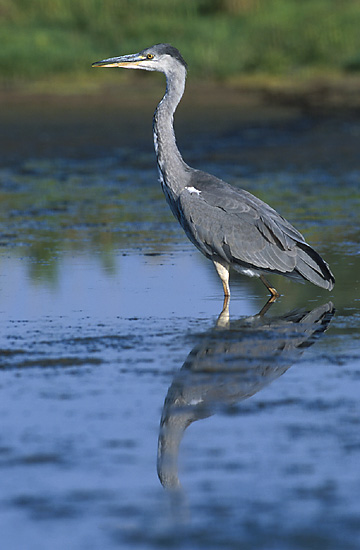
Gray heron (Ardea cinerea). Photo: Marek Szczepanek / Wikimedia Commons / CC BY-SA.
Habitat types covered
Rivers, ponds & stream margins
River channels
Fast and slow-flowing rivers present entirely different light conditions. A narrow forested stream in the Bieszczady blocks direct sun for most of the day; a wide Vistula reach can remain open to sky for kilometres. Knowing which type you’re shooting shapes every other decision.
Pond & oxbow margins
Still or near-still water reflects the sky directly, which creates strong contrast between lit and shaded zones. Oxbow lakes — old river bends cut off from the main channel — tend to hold denser emergent vegetation, providing cover for wading birds and perching kingfishers.
Wetland & bog streams
The Biebrza basin contains one of the largest peat bog complexes in Central Europe. Streams here run slow and tea-coloured with dissolved organic matter. The flat landscape and open horizon mean that morning and evening light travels far across the water, often producing long, flat reflections.
Get in touch
Contact
Questions about the content, corrections, or field observations from Polish freshwater habitats can be submitted below.
This form does not transmit data to any server. Submissions are handled in the browser only.